


Between 1997 and 1998 I attended a series of courses on retail, store management and sales promotion at SDA Bocconi. Esselunga was the case study everyone used back then — the "Italian Sainsbury's," the chain nobody could really touch on customer focus. My family has been shopping there since the mid-'70s, when they opened their first store in Lucca, so by the time I sat through those classes I already had twenty years of first-hand experience with the company those slides were describing in such glowing terms.
The produce department was always the proof point. Fruit and vegetables, consistently fresh, turning over fast, backed by a replenishment discipline that felt almost religious: shelves simply did not stay empty. That was the dogma. Fidaty, one of the first loyalty programs in Italy, grew straight out of that same culture — knowing the customer wasn't a marketing line, it was how the business actually ran.
Today that same department tells a different story, and I see it every time I do my weekly shop. Packaged fruit rotting in the tray. Salads labelled "packed today" that you'd be embarrassed to put on your own table, let alone a shelf. A produce range that, in late June, is still stocking cabbages, kale and pumpkins while the summer assortment crawls in. Shelves that go empty and stay empty for hours, not minutes. And aisles half-blocked by the oversized trolleys staged for home-delivery picking, always at the worst possible time of day.
I don't think it's just me. The numbers seem to agree.
What the numbers say
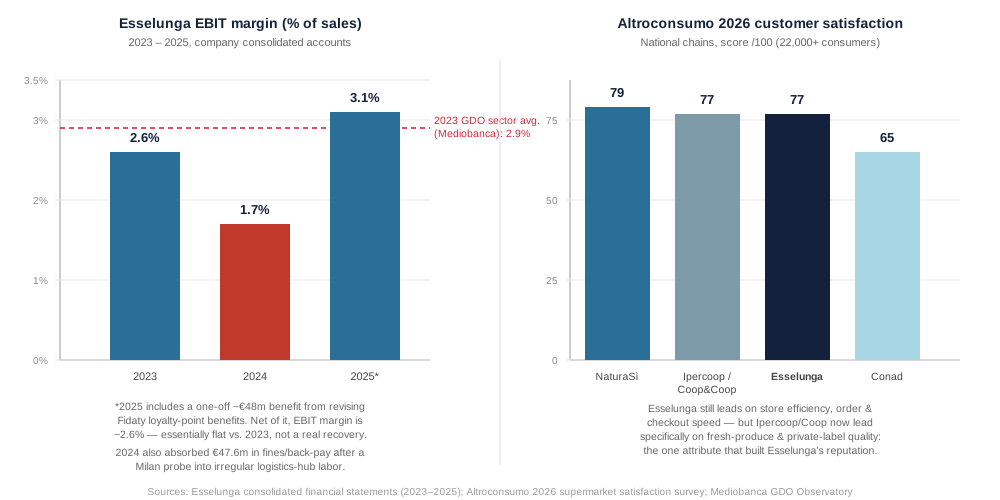
Altroconsumo's 2026 survey, based on more than 22,000 consumers, still puts Esselunga in the top tier of Italian supermarket chains. But it's no longer alone up there. NaturaSì leads with 79 points out of 100; Ipercoop and Coop&Coop are tied with Esselunga at 77. And the detail that actually matters: the survey credits Esselunga's strength to store efficiency, tidiness and checkout speed — while crediting Ipercoop and Coop specifically for fresh-produce and private-label quality. That's the one thing Esselunga used to own without question.
The financials tell roughly the same story as the shelf. EBIT margin dropped from 2.6% in 2023 to 1.7% in 2024, at a point when, per Mediobanca's GDO Observatory, the sector average was sitting around 2.9%. A company the trade press used to call "the benchmark" had quietly slipped below it. 2024 was also the year Esselunga paid out around €47.6m in fines and back-pay after a Milan prosecutor's investigation into irregular labor at its logistics hubs — the same hubs that handle fresh produce. Margin bounced back hard in 2025, to 3.1% — but about €48m of that recovery came from a one-off revision of Fidaty loyalty-point benefits. Strip that out and EBIT margin is closer to 2.6%, basically flat versus 2023. Not the recovery the headline number suggests.
I find that last detail genuinely telling: the loyalty program built on a culture of putting the customer first is now, in part, a lever for protecting the margin.
Where Theory of Constraints comes in
This is exactly the kind of situation Goldratt was talking about. A company's goal isn't to squeeze the best result out of today, and it isn't to protect some hypothetical future at today's expense either — it's to keep growing Throughput, now AND in the future, at the same time. Optimize a local metric — departmental margin, shrink rate, logistics cost per unit handled — without checking what it does to the system's ability to generate Throughput down the road, and you get exactly this: every individual decision defensible on its own, the aggregate result indefensible.
One of the cleaner ToC tools for surfacing this kind of self-inflicted conflict is the Goal Tree: start from the Goal at the top, work backward to the Critical Success Factors that are necessary — but not sufficient — for it, then to the Necessary Conditions underneath each CSF. Built generically for a food retailer, it looks like this:
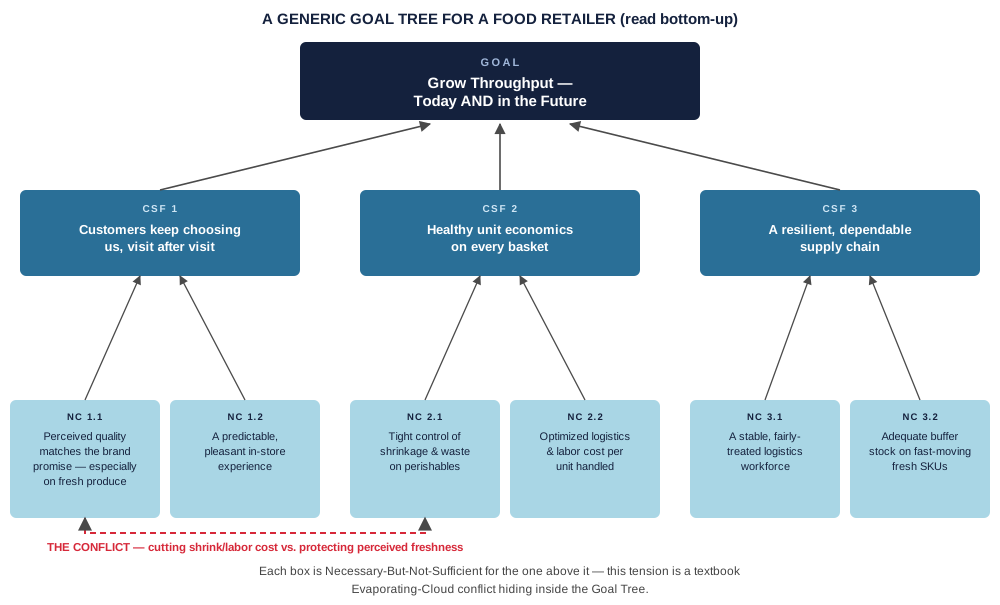
Two Necessary Conditions are pulling against each other: protecting perceived quality on fresh produce, because that's what earns repeat visits, and tightly controlling shrink and labor cost on perishables, because that's what protects the basket's margin. Push too hard on either side and you damage the other. Going by what's on the shelf and what the survey says, the balance right now is tilted toward the cost side, at the quality side's expense. That's not a one-off operational slip — it's a structural conflict sitting inside the Goal Tree, exactly the kind of thing Goldratt would have you surface with an Evaporating Cloud rather than firefight store by store.
My guess is there's a policy constraint behind it too: an unwritten rule, lived out in buying, store operations and supply chain decisions, that today rewards containing the cost of handling fresh produce more than it rewards having it available and good on the shelf. Fixing that doesn't take a big capital project. It takes the will to put the right measurement back at the center, even when that looks "less efficient" on a monthly P&L.
The open question
The real risk here isn't one shopper annoyed by June kale. It's the slow erosion of something intangible — the reputation of being the fresh-quality chain — built over decades and, once it cracks, far more expensive to rebuild than it was to lose. ToC makes the point almost bluntly: look at the system as a whole, because the real constraint is rarely sitting where everyone's eyes are fixed on the margin line.
I'd be curious whether other long-time customers are seeing the same thing, or whether I'm just biased by having grown up with the Esselunga that those SDA Bocconi slides used as the benchmark.
If you recognize this pattern in your own organization — a strength quietly turning into a constraint because nobody's measuring the right thing anymore — I'd like to hear about it. I write here regularly about applying Theory of Constraints and CCPM to real operational problems, not the textbook version. Drop a comment, or get in touch directly if you want to work through the Goal Tree or the underlying conflict together.
Sources: Esselunga consolidated financial statements, 2023–2025; Altroconsumo 2026 supermarket customer satisfaction survey (22,000+ respondents); Mediobanca GDO Observatory; trade press coverage of Esselunga's 2024–2025 results.


