


While in a moment of relaxation, under the beach umbrella, I was watching a few people preparing a nice aperitif. Some guests were already eager to sit and enjoy the moment — but the team serving them clearly hadn't thought about flow. Which, inevitably, got me thinking about Theory of Constraints. Factories, indeed, have the same problem-
Walk into almost any manufacturing plant and you'll find the same paradox: machines running, people busy, orders in progress everywhere — and yet deliveries consistently late.
The instinctive response is to look for more capacity. Add a shift. Buy another machine. Hire more people. And sometimes that helps, briefly, until the plant is busy again and the lateness pops up again.
I've been walking into factories for years. The problem is almost never capacity. It is flow. And fixing flow requires a fundamentally different way of thinking about how work moves through a plant.
That approach is called Simplified Drum-Buffer-Rope — S-DBR for short.
The real problem: local efficiency is killing your throughput
Most manufacturing plants are managed by a logic inherited from cost accounting: every workstation should be as productive as possible, every resource as fully utilized as possible, every minute of idle time eliminated.
This logic feels rigorous. In practice, it is one of the main reasons factories miss deliveries.
A manufacturing plant is not a collection of independent workstations. It is a system — a chain of interdependent steps through which work must flow in sequence. In any chain, the weakest link determines the speed of the whole.
If one workstation can process 100 units per day, the plant cannot produce more than 100 units per day, regardless of how fast everything else runs. Feeding work into the system faster than that workstation can handle it doesn't increase throughput. It creates queues. Queues create longer lead times. Longer lead times create late deliveries.
The nasty paradox is that a plant managed for local efficiency — where every workstation is pushed to run at maximum — almost inevitably produces exactly this result. Work floods in, queues build everywhere, and the factory is simultaneously very busy and very late.
This is not a people problem. It is not a planning problem. It is what Theory of Constraints calls the failure of local optimization. And in my experience, it is the norm rather than the exception.
What traditional scheduling tools miss
Most factories rely on MRP or ERP systems to plan production. These tools are sophisticated and widely trusted. They are also built on an assumption that doesn't hold in real manufacturing: that resources are independent of each other and can be scheduled in isolation.
MRP calculates start and end dates for every operation based on standard lead times and assumed capacity. It doesn't model variability — the machine breakdowns, quality issues, material delays, and rush orders that are simply part of life on any production floor. It assumes the plan will be executed as designed.
In practice, the plan starts diverging from reality the moment the first shift begins. And the system has no way to distinguish between the one workstation that actually limits throughput and the twenty that don't. Every resource looks equally important on the Gantt chart. Every delay looks equally urgent.
The result is a production floor where everything is being expedited simultaneously, the loudest customer gets prioritized, and the schedule is rebuilt every week from scratch.
From DBR to S-DBR — and why the distinction matters
The original Drum-Buffer-Rope concept was introduced by Eli Goldratt in The Goal and developed further in his subsequent work. It was a genuine advance in production scheduling — but it came with a practical complexity that limited how many companies could actually sustain it.
In the original DBR, the drum was always a physical internal resource — a specific machine or workstation whose finite capacity was modeled in detail to build a precise production schedule. In environments with high product mix, variable demand, or frequently shifting constraints, maintaining that drum schedule became a significant overhead in itself.
Eli Schragenheim, one of the most rigorous practitioners and authors in the TOC field, addressed this with Simplified DBR. His key insight was that in many manufacturing environments, the complexity of building and maintaining a detailed drum schedule is unnecessary. A time buffer at the shipping point, combined with controlled work release, achieves the same protective effect with considerably less planning effort.
The simplification is not just operational — it is also conceptual. S-DBR is easier to explain to a production team, easier to implement, and easier to sustain over time, although with some caution to consider. It preserves the essential logic of the original DBR while removing the complexity that made DBR difficult to maintain in dynamic real-world environments.
There is a deeper insight here that I find particularly compelling — and it is, I should say, my own reading of the connection rather than something you will find stated explicitly in the literature. It connects S-DBR directly to Critical Chain Project Management, and it goes beyond both methods simply using buffers.
Look at the diagram below. It shows a typical CCPM project network — tasks on the critical chain, feeding buffers, project buffer at the end. Now do one thing: replace the word "task" with "work centre" or "machine."
Suddenly it's a production floor.
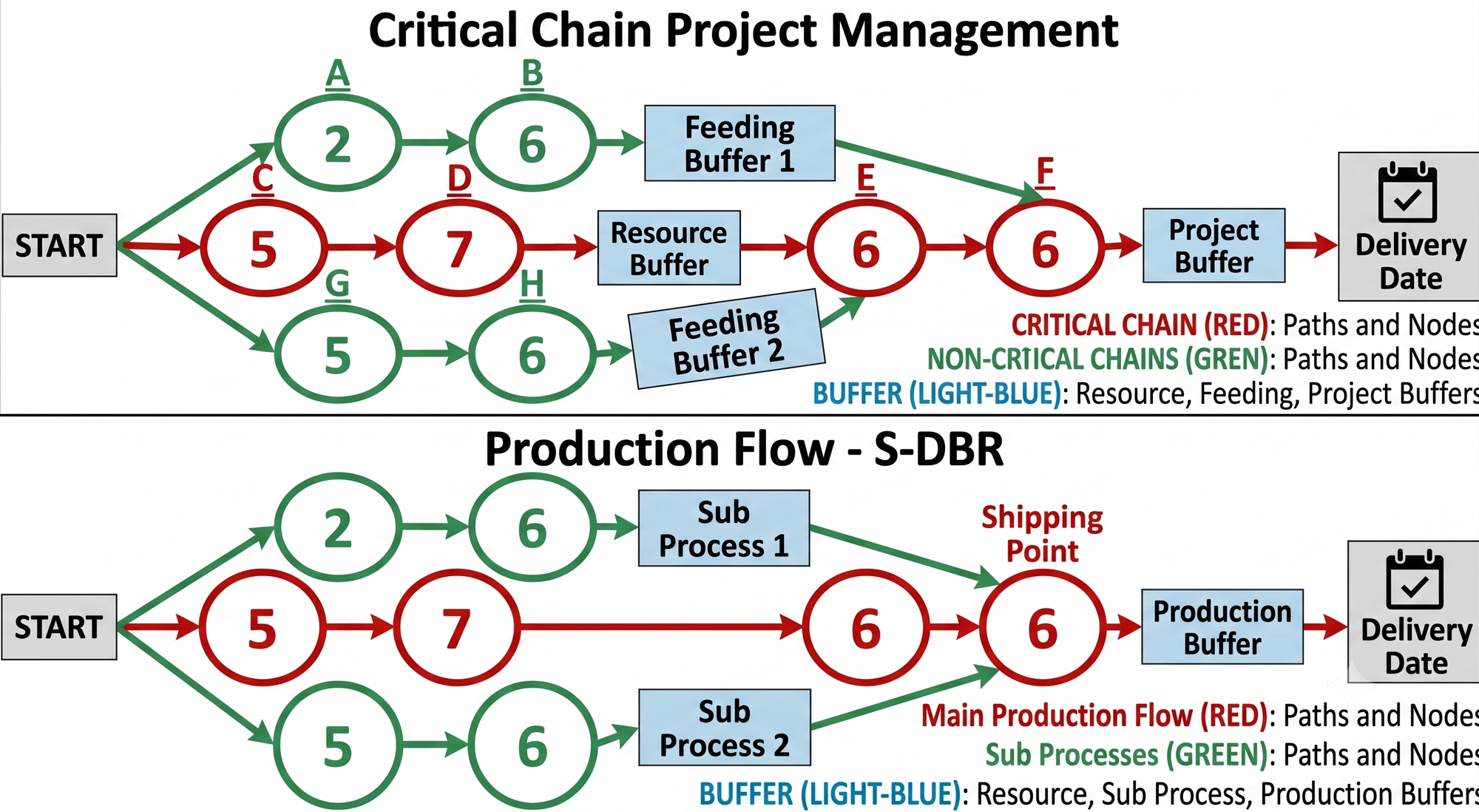
The critical chain is your main production sequence running through the bottleneck. The non-critical paths feeding into it? Think of your painting line that needs to finish before assembly can start. Or the sub-assembly cell that feeds the main line. Or the external supplier whose components need to arrive before anything can move forward. These are feeding buffers — most plants just don't call them that. If you change the labels, the diagram doesn't change: the logic is the same. Which, again, is not a coincidence.
If you are coming to TOC-based production management for the first time, S-DBR is where I would start.
How S-DBR works
The name reflects three core elements.
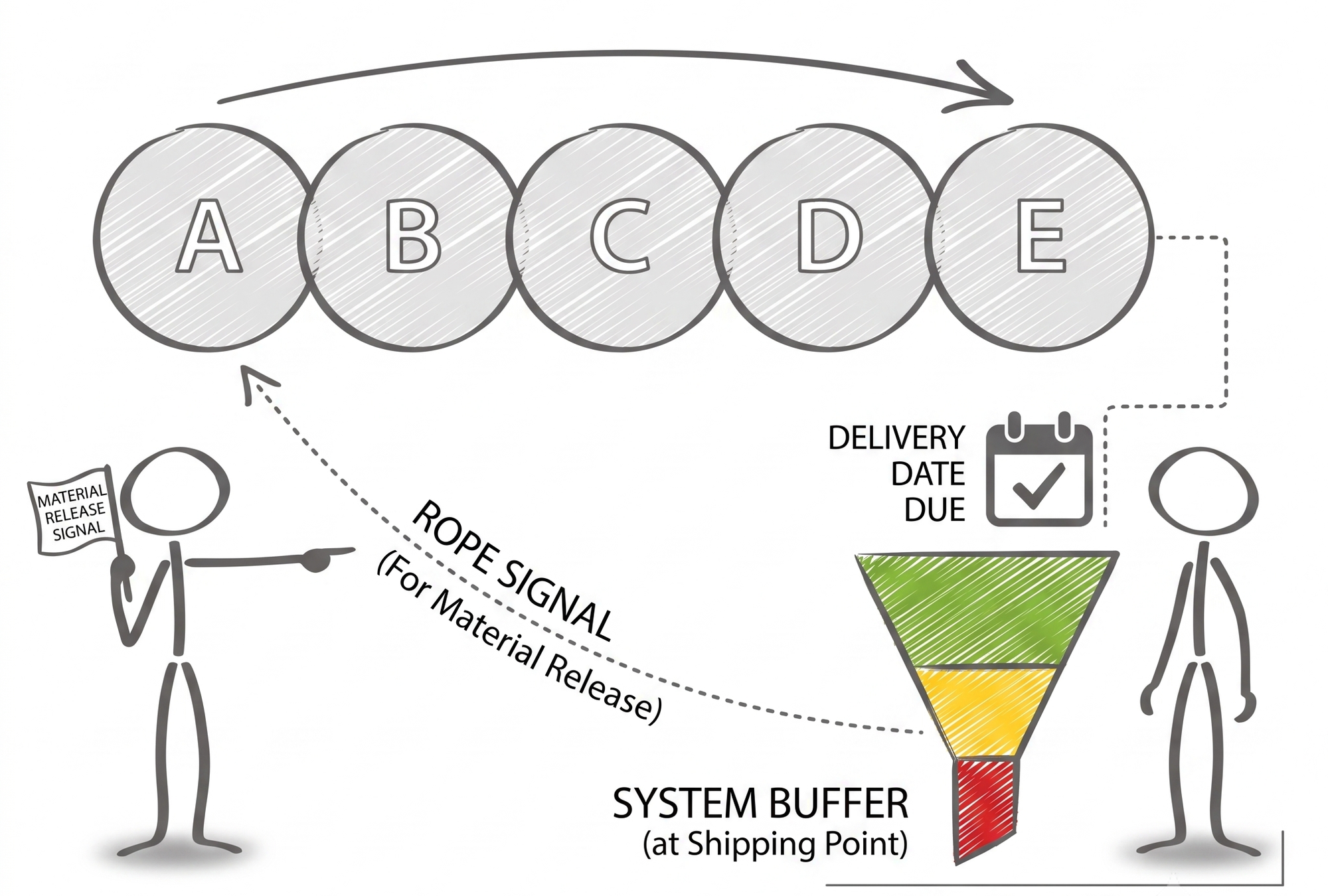
The Drum sets the pace of production. In environments where an internal resource indeed limits output — a specific machine, a paint line, an assembly cell — that resource is the drum, and its schedule drives everything else. In many modern manufacturing environments, however, the real constraint is market demand: the plant has more capacity than it has orders. In this case, the drum is set by customer delivery commitments, and the goal shifts from maximizing machine utilization to protecting those commitments reliably.
The Buffer is time — a planned time allowance placed in front of the constraint and at the shipping point to absorb the variability of the production process. If something goes wrong upstream — a breakdown, a quality rejection, a late delivery from a supplier — the buffer absorbs that disruption before it reaches the constraint or the customer. The buffer is not a pile of inventory. It is a time window that makes the system resilient without requiring everything to go perfectly.
The Rope controls when work enters the production system. In traditional scheduling, work is released as soon as it is ready. In S-DBR, release is tied to the constraint's schedule — the rope prevents work from being pushed into the system faster than it can be processed. This single change, in my experience, often produces the most immediate and visible results: WIP drops, queues shrink, and the constraint becomes visible because it is no longer buried under work that arrived too early.
Managing by buffer status
Once S-DBR is running, the primary management tool is buffer status — a nearly real-time indicator of how much of the time buffer has been consumed for each order in the system.
Like the fever chart in CCPM, buffer status divides orders into three zones:
- Green — the order is progressing normally. No action needed.
- Amber — the buffer is being consumed faster than expected. Worth checking where the order is and whether anything needs attention.
- Red — the buffer has been significantly consumed. This order is at risk. Act now, starting with the constraint.
This replaces the daily expediting meeting — where everyone argues about which order is most urgent — with a simple, objective priority system. Red orders move first. Amber orders are watched. Green orders are left alone. Production supervisors spend less time in meetings and more time on the floor.
What results look like in practice
Manufacturers who implement S-DBR seriously typically see the first results within ninety days:
- Lead times drop by 30–50% — often the earliest and most visible change, because WIP falls sharply once work release is controlled
- On-time delivery climbs above 90% — achievable even in environments where 70% was considered acceptable
- WIP reduces by 30–40% — freeing floor space, reducing handling, and releasing cash tied up in inventory
- Throughput increases without capital investment — because the constraint is now properly exploited rather than buried
That last point matters. In most implementations, the capacity to produce more was already there. It was hidden by the noise of local optimization — by the queues, the expediting, the constant rescheduling that consumed both machine time and management attention. Removing that noise reveals capacity that was always there, waiting.
The uncomfortable truth about utilization
S-DBR asks manufacturing managers to accept something that feels deeply counterintuitive: that some machines should sometimes be idle.
If the constraint processes 100 units per day, a feeder workstation that can process 150 should not run at 150. It should run at 100 — and then stop. Running faster only creates WIP that cannot move forward.
This conflicts directly with the utilization metrics most plants use to evaluate performance. A supervisor measured on machine utilization has every incentive to keep running. And every S-DBR implementation will eventually hit this wall.
The resolution is a management decision: replace utilization with throughput as the primary measure of production performance. A machine that is idle because the constraint is running smoothly is not a problem. It is the system working as it should.
In my experience, once a production team sees lead times drop and deliveries get stable, the argument for the old metrics loses its force quickly. Results are a more persuasive teacher than any training course.
A note on ERP
The most common question I get from operations directors is whether S-DBR means replacing the ERP. It doesn't.
S-DBR sits alongside ERP as a production execution layer. The ERP handles purchasing, materials planning, costing, and customer order management. S-DBR handles the sequencing and flow of work on the floor — the part that ERP has always done poorly. The two complement each other.
In practice, this means no major IT project. The constraint is managed directly. Buffer status is tracked with simple tools — sometimes a spreadsheet in the early stages. The ERP continues to do what it does well.
Where to start
If your plant is running at high utilization but struggling to deliver on time — if your production meetings feel more like firefighting sessions than planning discussions — the question worth asking is not "where do we need more capacity?"
The right question to ask is: where is the constraint, and is everything else subordinated to it?
In most manufacturing environments I have worked in, that question is answerable within a couple of days of looking at the right data. What comes after is a matter of discipline, not complexity.
If you'd like to work through that question together — and see what S-DBR would look like in your specific environment — get in touch. I've been inside enough factories to know where to look.
Oh, one last thing: the aperitif eventually arrived, making everyone happy. And the bottleneck was obvious to anyone who knew where to look, as it always is.