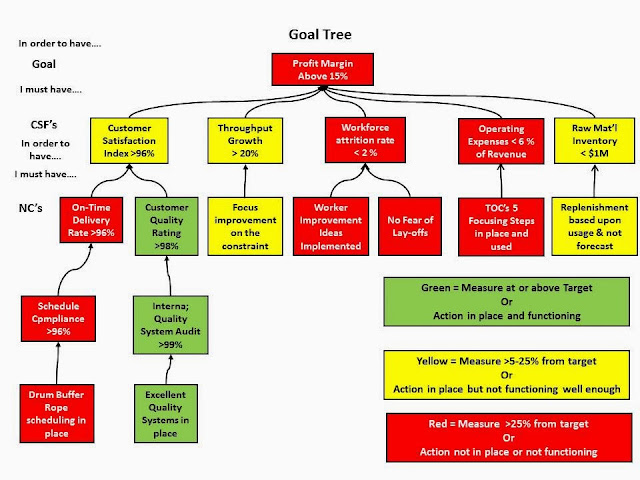
A Goal Tree (also called a Goal Map) is a visual tool that clarifies the relationships between a system's overall purpose and the conditions required to achieve it. It was developed by Bill Dettmer, a leading Theory of Constraints consultant and founder of Goal Systems International.
The diagram is built on necessity relationships: for any element to be achieved, every element connected below it must also be achieved. Each arrow represents that dependency — read as "in order to achieve X, I must first have Y."
How it works in practice
As you can see in the above picture, at the top sits your Goal — the single overarching aim of the system (for example, a profit margin above 15%, or on-time delivery above 95%).
Below the goal you'll have your Critical Success Factors — the conditions that must be in place for the goal to be achievable. These are not tasks; they are states that must exist.
At the base are your Necessary Conditions — the specific, concrete requirements that underpin each Critical Success Factor.
The power of the Goal Tree is that it makes the logic visible. Once you can see the full chain of necessity, it becomes immediately clear where the real gap is — and therefore where to focus improvement effort.
When to use it
A Goal Tree is particularly useful at the start of an improvement initiative, before diving into solutions. It forces a team to agree on what success actually looks like, and to surface the assumptions — often unstated — about what needs to be true for that success to be possible.
It connects naturally to the Five Focusing Steps: the Goal Tree tells you where you want to go; the 5FS tells you how to get there by managing the constraint that's blocking progress.
If you'd like to see how a Goal Tree could bring clarity to your business priorities, get in touch.