

Single-project CCPM is relatively straightforward. You identify the critical chain, strip out the individual task buffers, build a project buffer at the end, and manage by exception using the fever chart.
Most organizations, however, don't run one project at a time.
They run five. Or fifteen. Or fifty. With the same engineers, the same production lines, the same key specialists appearing in project after project — simultaneously. And this is precisely where traditional project management doesn't just underperform. It breaks down entirely.
The multi-project problem nobody talks about
When resources are shared across multiple concurrent projects, the scheduling assumptions that underpin the Critical Path Method collapse. CPM can model dependencies within a single project. It cannot adequately model the human being who is the critical resource on three projects at once.
What happens instead is well-documented and universally recognized by anyone who has managed projects in a real organization:
The resource gets pulled in multiple directions simultaneously. They context-switch constantly. Each project manager applies pressure for priority. The resource, unable to satisfy everyone, does what rational people do under conflicting demands — they multitask, spreading their attention across everything and completing nothing efficiently.
The result is a phenomenon called the multitasking trap: every project appears to be progressing because the shared resource is touching everything. But nothing actually finishes. Projects queue behind each other invisibly, waiting for a resource that is technically "assigned" but practically almost unavailable.
This is not a people problem. It is a system problem. And it requires a systemic solution.
What changes in a multi-project environment
Single-project CCPM gives you a critical chain and a project buffer. Multi-project CCPM adds a third concept that is specific to this context: the drum resource.
The drum resource is the capacity constraint of the entire multi-project system — the one resource (or resource type) whose availability determines how fast the organization can move projects through the pipeline. In most organizations this isn't hard to identify: it's
- the senior engineer who appears in every project plan,
- the specialized technician with unique skills,
- the testing environment everyone shares,
- the external certification body with fixed turnaround times, you name it!
Once identified, the drum resource becomes the anchor around which the entire project portfolio is scheduled. Everything else — start dates, sequencing, resource allocation — must be subordinated to protecting and exploiting the drum.
This is the Theory of Constraints logic applied at the portfolio level. The drum resource is the constraint. You exploit it by ensuring it is never idle waiting for upstream work. You subordinate everything else to its rhythm. And you protect it with buffers — specifically, capacity buffers that absorb variation before it reaches the drum.
The five implementation steps
1. Identify the drum resource
Start by mapping all active and planned projects against the resources they require. Look for the resource that appears most frequently, that causes the most scheduling conflicts, and that — when unavailable — brings multiple projects to a halt simultaneously.
In manufacturing environments this is often a specific machine or process. In professional services it tends to be a senior expert or a small team with specialized knowledge. In IT projects it is frequently the testing and QA function.
Now, let's be honest about this: organizations don't like (and hence often resist) naming a constraint because it implies a weakness. In TOC logic, instead, identifying the constraint is not a failure — it is the prerequisite for every improvement that follows.
Identifying the constraint is not a diagnostic exercise — it is a strategic decision. Once you name the drum resource, you are committing to organize the entire project portfolio around it. That takes courage, because it makes priorities explicit and removes the comfortable ambiguity that allows everyone to believe their project comes first. But it is precisely that clarity that makes the system work.
2. Stagger project start dates around the drum
One of the most counterintuitive aspects of multi-project CCPM is that starting fewer projects simultaneously produces better overall throughput than starting everything at once.
The logic is straightforward. If the drum resource can only advance one project at a time at full capacity, launching five projects simultaneously means each project gets one-fifth of the drum's attention. All five move slowly. None finishes quickly.
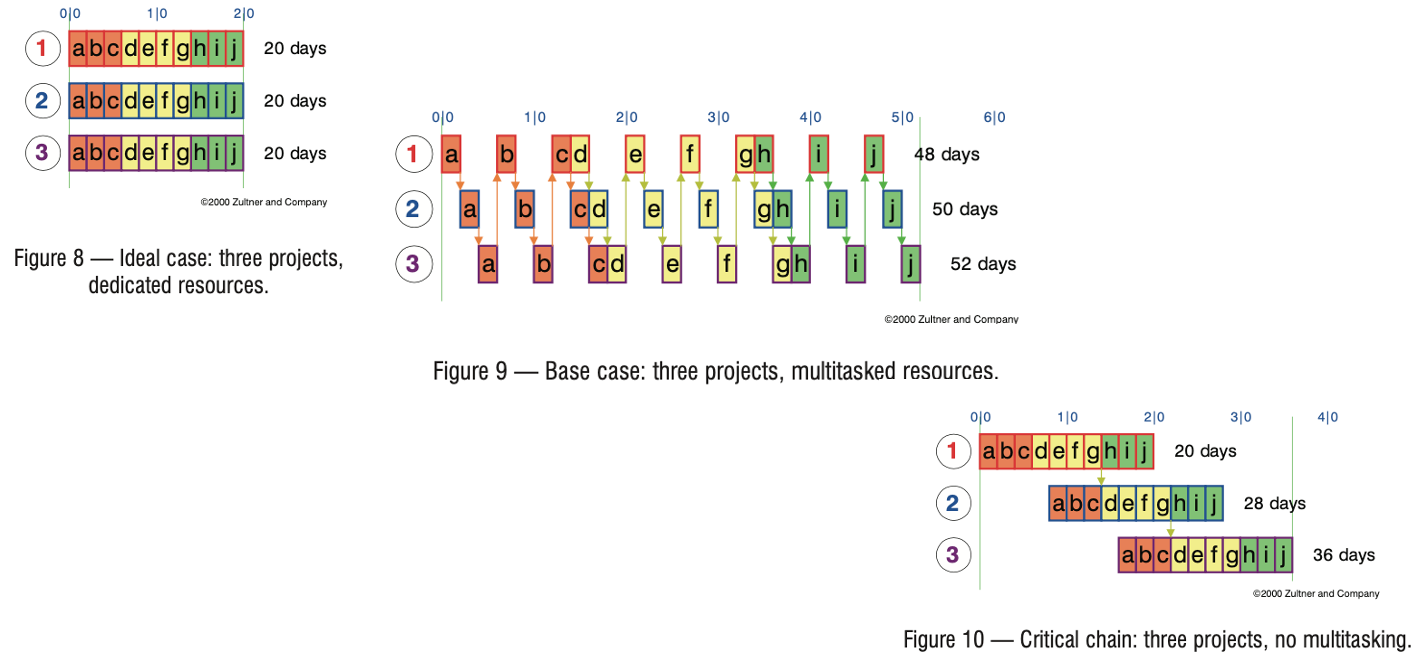
Staggering start dates so that the drum resource completes its work on one project before the next project reaches that stage keeps the drum fully utilized without splitting its attention. The pipeline flows faster. Individual projects finish sooner. And the organization delivers more completed projects per unit of time — which is the only metric that actually matters.
The practical implication: when a new project is proposed, the first question is not "when can we start?" but "when does the drum resource become available for this project's critical chain?" That answer determines the start date.
3. Build the project network with resource dependencies explicit
In single-project CCPM, the critical chain accounts for both task dependencies and resource dependencies within that project. In multi-project CCPM, resource dependencies span across projects — and must be mapped explicitly.
This means building a consolidated resource plan that shows every project's demand on the drum resource plotted against time. Where conflicts exist — where two projects need the drum simultaneously — one must wait. The sequence is determined by strategic priority, deadlines, and customer commitments, not by whoever applies the most pressure in a weekly meeting.
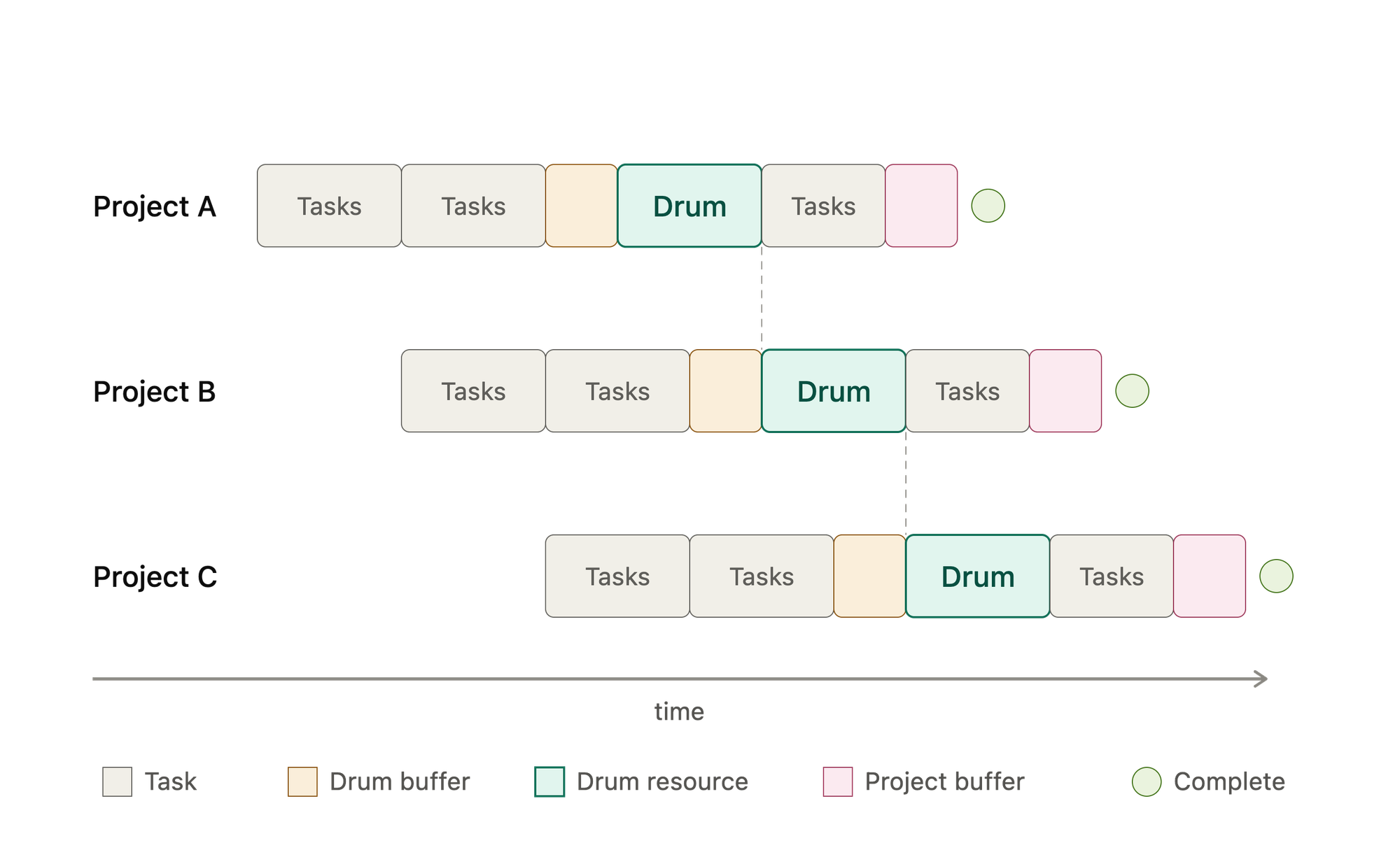
This is an uncomfortable process for many companies because it makes conflict visible. Projects that felt urgent and concurrent are suddenly competing for explicit priority. That visibility is not a problem — it is the point. Hidden conflicts managed through informal pressure produce chaos. Explicit conflicts managed through clear priority produce flow.
4. Insert capacity buffers before the drum
In single-project CCPM, feeding buffers protect the critical chain from delays arriving from non-critical paths. In multi-project CCPM, capacity buffers serve an analogous function at the portfolio level — they are planned gaps in the drum resource's schedule that absorb variation before it causes ripple effects across multiple projects.
A drum resource scheduled at 100% capacity has no ability to absorb delay. When one project runs late (and some always will), the delay propagates immediately to every downstream project in the queue. A drum resource scheduled at 75-80% capacity has absorption built in — delays are contained rather than cascading.
This feels wasteful to businesses accustomed to measuring resource utilization as a performance metric. It is not wasteful. A drum resource running at 80% with stable throughput delivers more completed projects than the same resource running at 100% with constant context-switching and cascading delays. The capacity buffer is not idle time — it is systemic resilience.
5. Manage the portfolio by buffer status, not by task completion
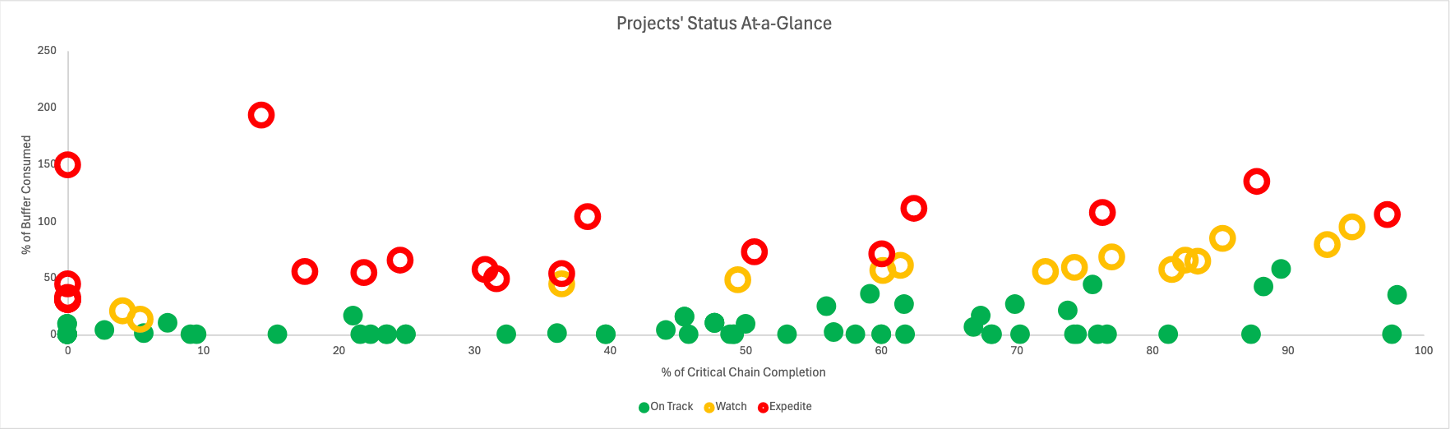
The fever chart logic from single-project CCPM extends directly to the multi-project environment. Each project has its own buffer status — green, amber, or red — based on how much of its project buffer has been consumed relative to how much of the critical chain has been completed.
At the portfolio level, this gives management a single, coherent view of the entire project pipeline: which projects are healthy, which are showing early warning signals, and which require immediate intervention. No more status meetings where every project manager reports progress in percentage complete. No more surprises when a project that was "90% done" misses its deadline by three weeks.
The fever chart portfolio view also makes prioritization decisions explicit. When two projects are simultaneously showing amber, management can make an informed choice about where to direct the drum resource — based on buffer status, strategic importance, and downstream consequences — rather than reacting to whoever shouts loudest.
The cultural shift is the hardest part
The mechanics of multi-project CCPM are learnable in a day. The cultural shift takes longer.
Most project-driven companies have developed informal systems for managing resource conflicts: the politics of priority, the relationships between project managers, the unwritten rules about whose projects get the best resources. Multi-project CCPM makes all of this explicit and replaces it with a system-level logic.
This is experienced as a loss by people who were skilled at navigating the informal system. It is experienced as a relief by people who were exhausted by it.
The most important thing senior management can do during implementation is to protect the drum resource from informal pressure. The moment the drum resource is pulled off a scheduled task because a senior stakeholder applied pressure outside the system, the credibility of the whole approach is undermined. The sequencing logic only works if it is respected.
In my experience, this is not a technical challenge. It is a leadership challenge. And it is the one that determines whether CCPM delivers its potential or becomes another initiative that faded after the training course.
What results should you expect
Organizations that implement multi-project CCPM with genuine management commitment typically see:
- 30-40% reduction in average project duration
- Significant increase in the number of projects completed per year — without adding resources
- Reduction in work-in-progress — fewer simultaneous active projects, each moving faster
- Improved predictability — management knows earlier which projects are at risk, with enough time to act
The last point is underrated. The value of CCPM in a multi-project environment is not just that projects finish faster: it is that businesses stop being surprised. The fever chart gives visibility weeks or months before a traditional percentage-complete report would flag a problem. That early warning time is where recoveries happen.
A note on software
Manual implementation of multi-project CCPM is feasible for small portfolios — three to five projects with a clearly identifiable drum resource. Beyond that, the complexity of tracking buffer status across multiple projects, managing drum resource scheduling, and maintaining an up-to-date portfolio view makes dedicated software a practical necessity rather than a luxury.
I work with Lynx CCPM by A-dato, which I support in Italy, precisely because it was built for this environment from the ground up. It models the drum resource, manages capacity buffers, tracks fever chart status across the entire portfolio, and surfaces the right information for management decisions — without requiring project managers to maintain the underlying logic manually.
If you are evaluating CCPM software for a multi-project environment, the key question to ask any vendor is not "does it support CCPM?" but "how does it handle resource conflicts across simultaneous projects?" The answer will tell you quickly whether the software was designed for this problem or retrofitted to claim compatibility.
Where to start
If your organization is running multiple projects with shared resources and experiencing the symptoms described here — constant firefighting, projects stuck near completion, key people permanently overloaded — the starting point is not a software purchase or a methodology training course.
The starting point is an honest answer to one question: who or what is the drum resource in your project portfolio?
Everything else follows from there.
If you'd like help working through that question — and what it implies for your project pipeline — get in touch. I've been inside this problem long enough to know where the surprises usually are.