
In his book "What is this thing called Theory of Constraints and how should it be implemented?", Eli Goldratt emphasises the importance of listening to our intuition — too often underestimated — and the need to verbalise what we already know. At some level, every business owner knows what the real problems are, and often knows the solution too.
The first step is to recognise that every organisation exists for a purpose, and that every part of the system should be evaluated by its impact on that specific goal. Before anything else, we need to clearly define the overall goal of the business and the measures that let us assess how local decisions — made within any sub-system — affect the global outcome.
To improve that global goal, we need to analyse processes through a specific lens: one that identifies, among the thousands of things that could be improved, the one or two that will have a genuinely significant impact.
"Not every change is an improvement, but certainly every improvement is a change." — Dr. Eli Goldratt
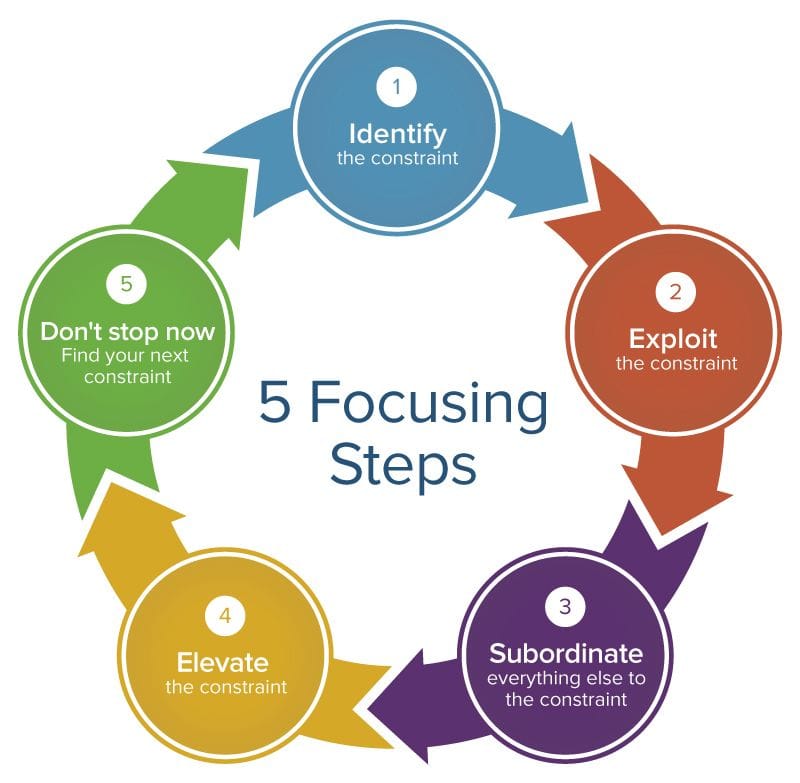
The Five Focusing Steps is the process for "treating" a constraint. The steps reflect two distinct time horizons. The first three address the short term:
- Identify the constraint
- Exploit the constraint — decide how to get the most out of it
- Subordinate everything else to that decision
The final two steps look to the medium and long term, creating the conditions for growth without sacrificing stability:
- Elevate the constraint — take action to remove or expand it
- Repeat — go back to step 1, and avoid letting inertia become the new constraint
No additional resources are needed. The 5FS is simply about focusing attention on what truly matters for reaching the overall goal.
Want to see how this applies to your business? Contact us for a free consultation — we'd be glad to help.